Evidence and disclosure,
built for scrutiny.
A governed evidence vault carries provenance and hashing from the moment material is captured through to exhibit management, disclosure schedules and court bundles. Trace Vantage produces tamper-evident audit and provenance records designed to support evidential scrutiny, so the account of how material was handled travels with the material itself.
Not every output is evidence. Working intelligence and investigative leads are handled separately and promoted into governed evidence and disclosure workflows only when relevant. The platform records the handling and integrity of material; decisions on relevance, use and admissibility remain with investigators, disclosure officers, prosecutors and the court.
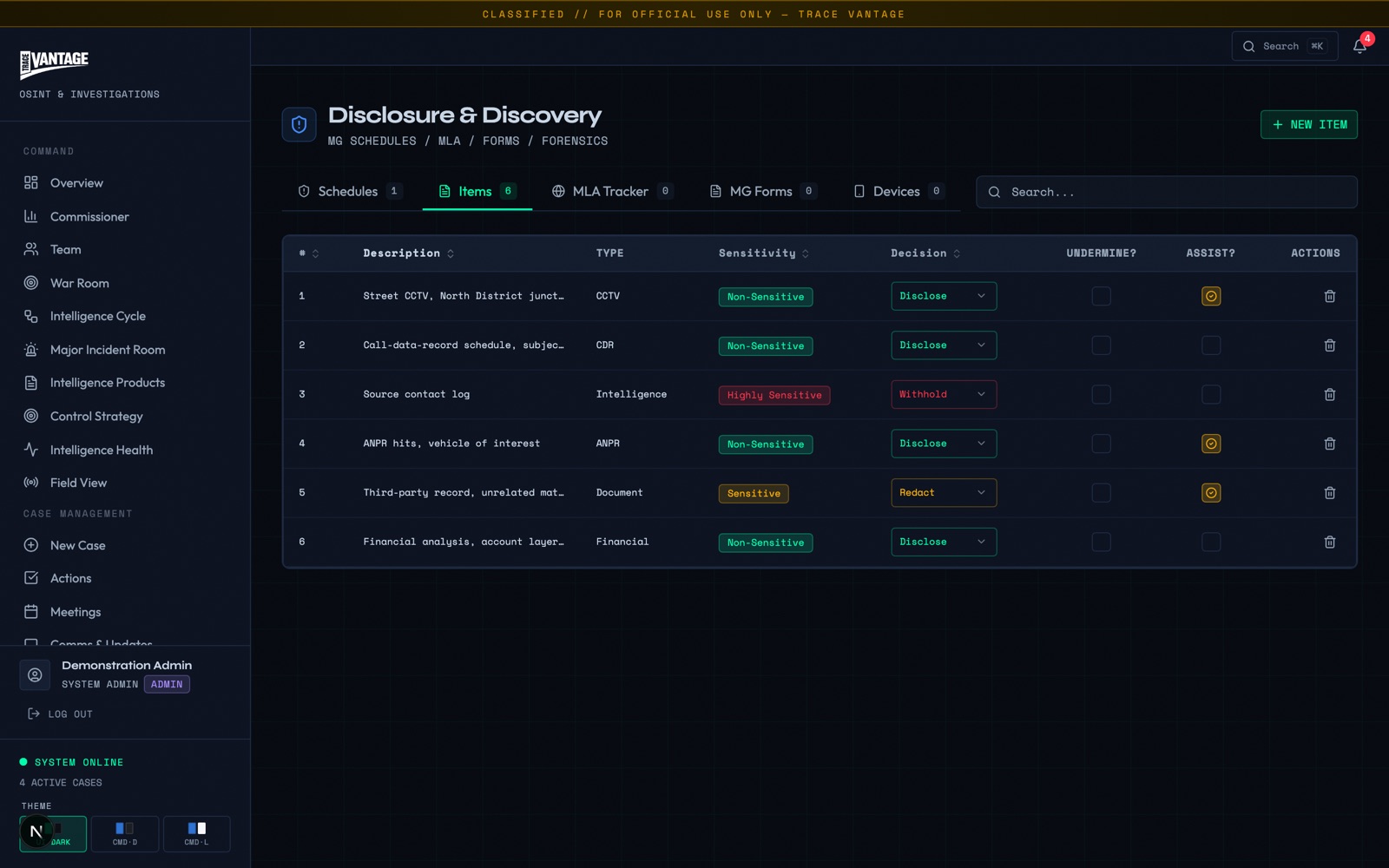
Provenance travels with the material.
The integrity and chain-of-custody record is created once, at source, and threads through every stage unbroken. Unused and sub-threshold material is recorded on the disclosure schedule rather than discarded.
One governed store for evidential material.
Material can be promoted into governed evidence and disclosure workflows from collection, forensic extracts, provider returns and analytical work, without leaving the force environment. Each item is held under force identity with role-based access, retention controls and a continuous record of who touched it and why.
Governed intake
Working material is quarantined from the evidential record until it is explicitly promoted under supervisory control.
Provenance on entry
Source, method and handling are captured as material enters the vault, not reconstructed afterwards.
Retention & access
Role-based access and retention schedules stay under force identity and policy.
Nothing leaves
Evidential material remains inside the force environment throughout its lifecycle.
Hashing and provenance that travel with the exhibit.
Cryptographic hashing and a continuous chain-of-custody record give each exhibit a tamper-evident integrity trail. These are provenance and integrity records designed to support evidential scrutiny; they describe how material has been handled, not whether it is admissible.
Cryptographic hashing
Exhibits are hashed on capture and re-verified on movement, so any change to the underlying material is detectable.
Chain of custody
Every access, transfer, copy and promotion is recorded against force identity with a timestamp and stated purpose.
Tamper-evident audit
The audit record is append-only and independently verifiable, so the handling history cannot be silently rewritten.
Provider & forensic lineage
Provider returns and forensic extracts retain their original source references and acquisition detail through to disclosure.
Jurisdiction packs
Handling categories, retention rules and disclosure formats are configured to the operating jurisdiction and carried into the pack.
From exhibit to court bundle, in one governed flow.
Exhibit management, disclosure scheduling and bundle production run on the same governed backbone, so court-readiness is embedded throughout the workflow rather than assembled at the end.
Exhibit management
Register, number and describe exhibits, link them to actions and statements, and track their status across the case.
Disclosure schedules
Build sensitive and non-sensitive schedules, with sub-threshold near-misses stated in the pack so borderline material is visible to the reviewer rather than dropped.
Court bundles
Assemble paginated bundles with exhibits, schedules, provenance and audit references, ready for review by disclosure officers and prosecutors.
Decisions on what is relevant, disclosable and admissible remain human decisions. The platform supports those decisions with a complete, tamper-evident record; it does not determine legal admissibility.
The AI's working travels in the bundle.
Every analytical product exports its own court-ready disclosure pack: JSON alongside a PDF, carrying a SHA-256 request hash for chain of custody and a methodology appendix that cites every model, tool version and cost that touched the underlying data. Where AI is in the loop, the supervisor approval chain is part of the record. The reasoning behind an output is disclosed with the output, not left unexplained.
Video analysis
Transcript, face, plate, object, location and audio-event findings, exported with uninvolved bystanders redacted and the full model and tool chain recorded.
Pattern-of-life
The geofence and multi-device intersection behind a movement picture, with its methodology and audit chain set out for review.
Device extract
Contraband and device-analysis findings, exported with their acquisition detail, hashing and the passes that produced them.
Social-graph build
Nodes, edges, evidence roll-up, cluster labels, monitoring deltas and the AI-use declaration, in a structured multi-section pack.
Cross-case resolution
The candidate and resolved links across cases, with the evidence and the supervisor's confirm or reject decision on the record.
Each pack shares one structure, cover, methodology, totals, detail and audit, so a reviewer reads every analytical product the same way, and can reproduce and challenge how a result was reached.
Provider returns and legal process, accounted for.
Requests to communications and platform providers, and the returns they generate, are tracked against the exhibits and schedules they support. Each return keeps its source reference, acquisition detail and handling record, so the route from legal process to court bundle is auditable end to end.
Request to return
Legal process is logged and linked to the material it produces, with status visible to the case team.
Returns as exhibits
Provider returns are ingested with provenance intact and promoted into evidence under the same controls as any exhibit.
Auditable throughout
Authorisation, receipt and handling are recorded so the account stands up to evidential scrutiny.
The questions a disclosure review has to answer.
Where did this material originate, and how was it acquired?
Has the exhibit changed since it was captured?
Who accessed it, and under what authority?
When did working material become governed evidence?
What is on the schedule, including sub-threshold near-misses?
What went into the bundle placed before the court?
See how evidence and disclosure hold up under scrutiny.
Review the vault, provenance model, disclosure schedules and court bundles against your own disclosure regime and assurance requirements.