Secure collaboration,
inside the case.
Investigators discuss, decide and coordinate in private case rooms and microcells that carry the same identity, handling controls and audit as the rest of the platform. Working conversation stays connected to the case, and relevant material is promoted into the governed evidence process rather than living in chat.
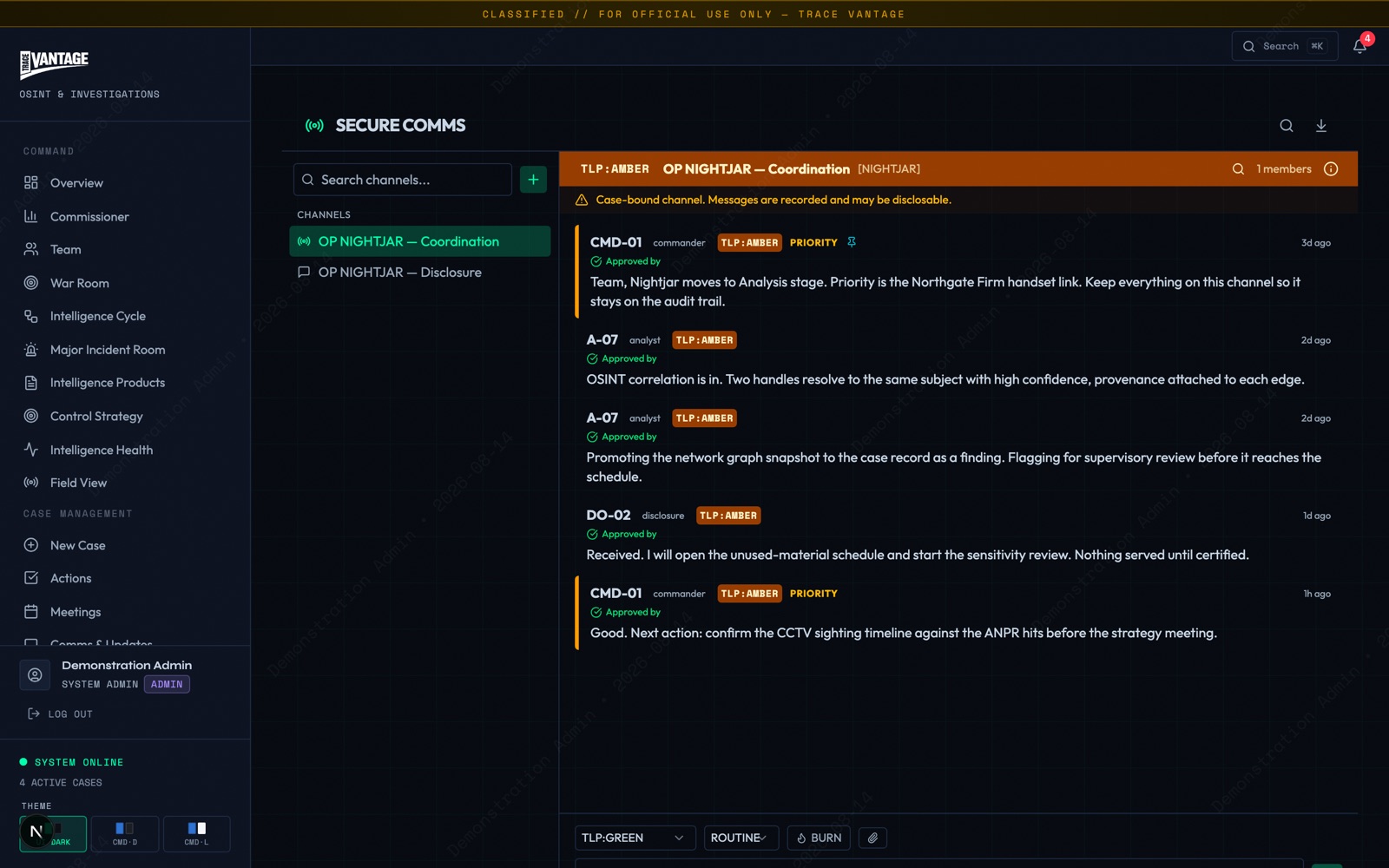
Investigative collaboration may contain incomplete, disputed or superseded material. Chat content is not treated as formal evidence by default. Relevant material must be promoted through the governed evidence process.
Private case rooms and microcells.
Each investigation has its own collaboration space, scoped to the people who are authorised to work it. Sensitive strands can be walled into microcells so that discussion is visible only to a named subset, while the wider team keeps working the main room.
Membership follows force identity and access controls. Adding, removing or restricting a participant is a governed action, recorded like any other.
Private case rooms
A dedicated space per investigation, scoped to authorised members and inheriting the case handling profile.
Microcells
Compartmented sub-spaces for sensitive strands, source-handling or covert lines, visible only to a named subset.
Direct messages
One-to-one and small-group threads for coordination, held under the same identity and audit as rooms.
Identity-driven access
Membership and visibility follow force roles; every change to a room is a recorded action.
Traffic Light Protocol and handling controls.
Conversations and shared files carry explicit handling markings so participants know how material may be used and onward-shared. Marking is applied at the room, thread and item level and travels with the content.
TLP markings
Apply Traffic Light Protocol handling to rooms, threads and shared items so onward-sharing expectations are explicit.
Handling caveats
Sensitivity, dissemination and source-protection caveats are attached to content and shown to every reader.
Controlled file sharing
Files shared into a room inherit the room's handling profile; access is scoped to members and recorded on view.
Warnings on re-share
Handling markings are surfaced when content is forwarded, promoted or exported, so decisions are made knowingly.
Retention is policy-led, not ad hoc.
Collaboration content is governed by the force's retention and records-management policy. Schedules, disposal and review are defined centrally and applied consistently, and legal hold overrides disposal whenever material is under obligation to be preserved.
Time-limited messages are available only as a policy-controlled option, configured and constrained by the force. They are never a substitute for records management, and they cannot remove material that is under legal hold or that has been promoted into evidence.
Policy-based retention
Retention and disposal follow force-defined schedules, applied consistently across rooms and threads.
Legal hold
Material under obligation is preserved and exempted from disposal until the hold is lifted by an authorised decision.
Records-management aware
Collaboration content is treated as a record, aligned to the force's information-governance regime.
Time-limited messages (optional)
A policy-controlled option where permitted; constrained by force configuration and always subject to hold and promotion.
Promote relevant material into evidence.
When a message, decision or shared file matters to the case, it is promoted through the governed evidence process rather than being treated as evidence in place. Promotion captures the item, its context and its provenance, and passes it into the evidence vault under the same handling and audit as any other exhibit.
Message-to-evidence promotion
Move a specific message or thread into the evidence process with its context intact.
Provenance carried forward
Author, time, room and handling travel with the promoted item into the vault.
Reviewer decision recorded
Who promoted the material, and on what basis, is captured as part of the record.
Evidence by process, not default
Chat remains working material until a person promotes it through the governed route.
Collaboration you can account for.
Complete audit
Rooms, messages, membership changes, handling changes and promotions are recorded in a tamper-evident audit trail.
Local deployment
Collaboration runs inside the force environment. Conversations, files and audit stay under force control, with no vendor access.
Consistent handling
The same identity, access, retention and handling controls apply here as across the rest of the platform.
Optional voice & video Available integration
Voice and video can be integrated under force control where an approved service is in place, subject to the same handling and audit.
Defensible boundary
Working conversation and the formal evidential record stay distinct, so what entered evidence is always clear.
Scrutiny-ready
Handling, retention and promotion decisions can be shown and explained under review and disclosure.
See secure collaboration in your operating context.
Bring your assurance and information-governance teams to a briefing and review how collaboration, handling and evidence promotion sit within force control.